How does AI learn?
Artificial Intelligence systems do not learn in the same way humans do.
Instead of understanding concepts, an AI learns by analyzing large amounts of data, recognizing patterns, and improving its performance through experience. This process is called machine learning, and it is the foundation of most modern AI systems.
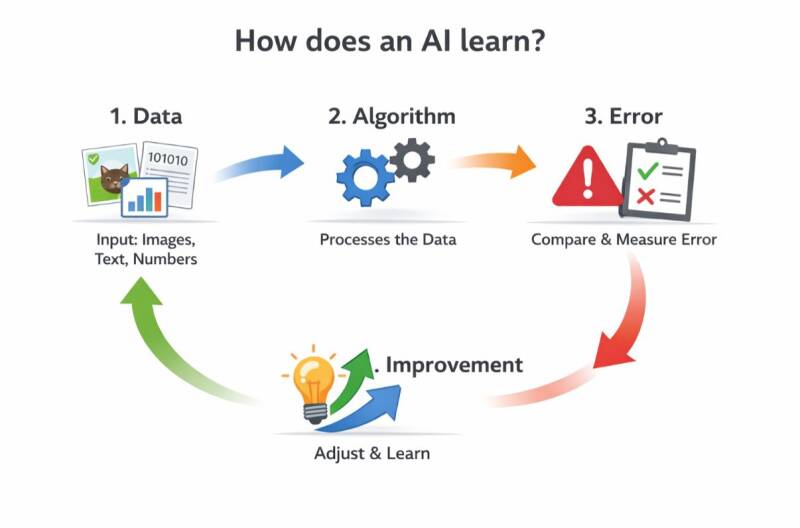
Data
Every AI system starts with data. This can include images, text, numbers, or sounds.
The more examples the system sees, the better it can recognize patterns and make predictions.
Data quality is very important: inaccurate or biased data can cause the AI to make mistakes.
Algorithm
The algorithm is a set of instructions that tells the system how to process data.
It analyzes the input and produces an output, such as predicting a value or classifying an image.
Different algorithms can produce different results even on the same data.
Error
The AI’s output is compared with the correct answer.
The difference between the predicted result and the real result is called error.
By measuring error, the AI understands how much it needs to improve.
Improvement
The AI adjusts its internal parameters to reduce errors.
This process is repeated many times, gradually improving performance.
Over time, the system learns to make more accurate predictions or classifications.
Machine learning allows AI systems to adapt and improve, making them extremely useful in real-world tasks.
However, it also highlights the importance of quality data and careful algorithm design, because mistakes or biases in learning can lead to inaccurate or unfair results.
Crea il tuo sito web con Webador